
Page County Criminal Court Cases
The Iowa District Court for Page County is the county's unified trial court. District judges hear felony matters, while district associate judges, associate judges, and magistrates handle assigned misdemeanor, criminal traffic, and other work. Page County does not have a separate city criminal court. A citation issued in Clarinda, Shenandoah, or Essex becomes a Page County District Court matter once it is filed.
The Page County Clerk of District Court keeps the official case file. That role is distinct from the sheriff, who keeps an arrest report or jail booking sheet, and from DCI, which maintains Iowa criminal-history data. The clerk's file follows the prosecution: complaint, trial information when used, appearances, pleas, motions, orders, disposition, judgment, sentence, and court debt. Iowa Courts Online gives a useful index, but the clerk remains the source for certified records and for help with older or missing Page County case material.
Page County's 17-Character Case IDs
Iowa court numbers contain 17 characters. The code identifies the county, year, case type, and sequence, so every character matters. A zero and the letter O are not interchangeable. When a Page County court case is already known, this full ID is the cleanest search key and the best reference to give the clerk. It avoids the false matches that can occur with a common name.
Case-type codes add a quick clue. FE generally marks a felony case. AG, SR, and SM indicate aggravated, serious, and simple misdemeanor cases, while OWCR marks an operating-while-intoxicated criminal category. These labels sort dockets. They do not state the final outcome or predict a sentence. Check each charge row, its statute, its status, and the judgment before drawing a conclusion.
- Complaint
- A sworn charging document that alleges facts constituting an offense.
- Trial information
- Iowa's formal felony charging instrument filed by the prosecutor when the court approves it.
- Disposition
- The result of a charge, such as conviction, dismissal, or acquittal.
- Deferred judgment
- A judgment held back while court-ordered terms are completed; successful discharge is not an ordinary conviction.
Searching Page County Case Records
Start with the official Iowa Courts Online trial-court search. Basic docket information is free. Advanced subscription access is listed by Judicial Branch guidance at $25 per month, but a guest can still locate core Page County case information. Search by the complete Case ID when possible. If it is not known, combine Page County with a partial name and a criminal case type.
- Open Trial Court Case Search rather than the appellate or payment-only screen.
- Enter the 17-character Case ID, or select Page County and enter part of the person's name.
- Narrow the results with the case type or date fields that the current access level displays.
- Open the matching docket, confirm the county and case ID, then read charges and events in date order.
- Give the clerk the case ID and exact document title when an official or certified copy is needed.
The state search screen shows the structure readers use for Page County case records.
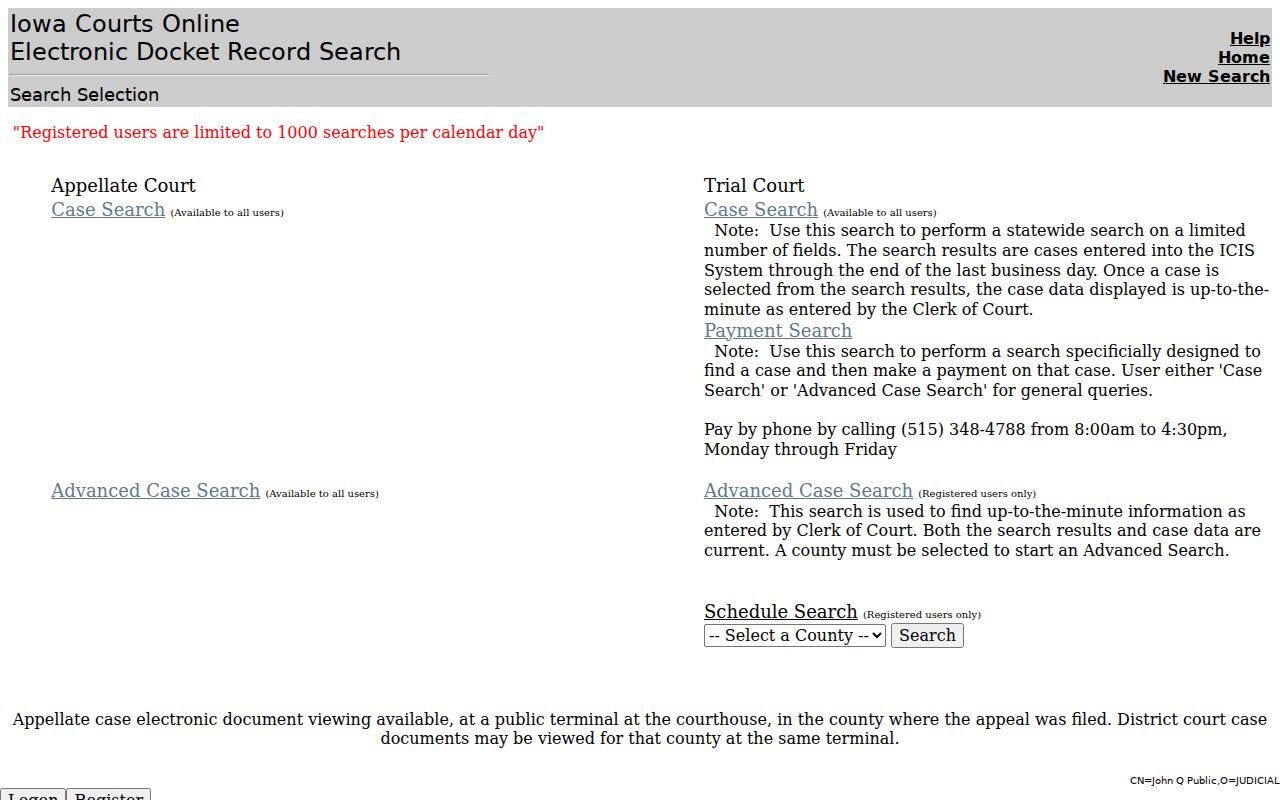
That screen is a route to the docket index, not a replacement for a signed or certified paper from the Page County clerk.
| Field or control | Type | Required | Page County search note |
|---|---|---|---|
| Case Search / Trial Court | Navigation | Yes | Choose trial-court records. |
| Case ID | Text | No | Use all 17 characters when known. |
| County | Dropdown | Search-dependent | Select Page for a local case search. |
| Last / Company Name | Text | Conditional | Partial names help when spelling varies. |
| First Name | Text | Conditional | Try the first few letters or a prior name. |
| Case Type | Dropdown | No | Use FE, AG, SR, SM, or OWCR when apt. |
| Date range | Date fields | No | Availability can depend on access level. |
| Search / Reset | Buttons | No | Runs or clears the query. |
Page County Docket Update Clocks
The search index and the live court docket do not always move at the same pace. Iowa's official help says the search index refreshes nightly. A new docket event may therefore exist before it appears in a broad name search. Citations present another delay: Judicial Branch guidance warns that a citation can take 10 to 14 days to reach the online system after it is issued.
If a recent Page County citation is missing, wait through that filing window and try a partial-name search. Check a prior surname if one may have been used. A city parking matter may never appear because Iowa Courts Online includes tickets filed with a county clerk, not every city administrative item. If the delay has passed, contact the clerk with the citation number, event date, and issuing agency. A public terminal at the clerk's office is also the practical fallback when the framed portal works poorly on a phone.
Note: A blank name search does not prove that no Page County criminal court case exists.
Inside a Page County Case File
A Page County docket can show the filed charge and what happened next. It does not usually contain the full police narrative or all details from a booking record. Read the header first, then the charge rows, event index, judgment, and financial ledger. A charge may be amended or dismissed, so the first allegation is not a safe summary of the outcome.
| Case ID and court | The 17-character identifier, Page County, case type, filing date, status, and assigned court information. |
|---|---|
| Parties and counsel | State of Iowa, displayed defendant name, and attorneys, with public identifiers limited. |
| Charging record | Complaint, citation, or trial information with statute, severity, and charge status. |
| Docket events | Appearances, motions, pleas, hearings, orders, judgment, and public warrant entries. |
| Disposition and sentence | The result of each charge, judgment, confinement or supervision terms, and related orders. |
| Financial record | Fine, surcharge, costs, restitution or other debt, payments, and balance entries. |
| Documents and redactions | A filing index may list papers not downloadable to guests; protected identifiers and sealed material stay restricted. |
The docket must be read as a sequence. "Dismissed" is not "convicted." A discharged deferred judgment is also not an ordinary conviction, though state criminal-history retention follows a different rule.
Official Page County Court Copies
Online information is expressly not the official record. For a certified order, judgment, charging document, or older file, contact the Page County Clerk of District Court at the Page County Courthouse, 112 E. Main Street, Clarinda. The general county line is 712-542-3219, but the current Judicial Branch court directory should be used to confirm the clerk's direct number and counter details.
Give the clerk the full case ID and the document title shown in the docket. Ask whether the copy will be plain or certified and request the current price before ordering. The research did not locate a current Page County copy or certification fee, so no fixed amount should be assumed. If an online entry appears wrong, identify the disputed row and ask the clerk to compare it with the official file.
Page County Clerk of District Court
Page County Courthouse
112 E. Main Street
Clarinda, IA 51632
712-542-3219 county-line fallback
Official criminal case files, certified copies, public terminal access, and correction of docket errors.
How a Criminal Case Moves
A Page County prosecution may begin with an arrest, a complaint, or a citation. The first court entries can include the complaint and initial appearance. The Page County Attorney then makes filing decisions; in felony practice, a trial information may become the formal charging instrument when approved by the court. Counsel appears, arraignment fixes the plea, and the case moves through discovery, motions, and hearings.
A plea can resolve the matter without trial. Otherwise, a trial leads to a verdict. The court then enters judgment and sentence, and later entries can record payments, review, appeal, or enforcement. This chain explains why a booking charge can differ from the filed or final charge.
Case flow: Charges Filed › Arraignment › Pretrial › Plea or Trial › Disposition › Sentencing
The Iowa court rules listings place electronic filing and public access in the wider procedural system.
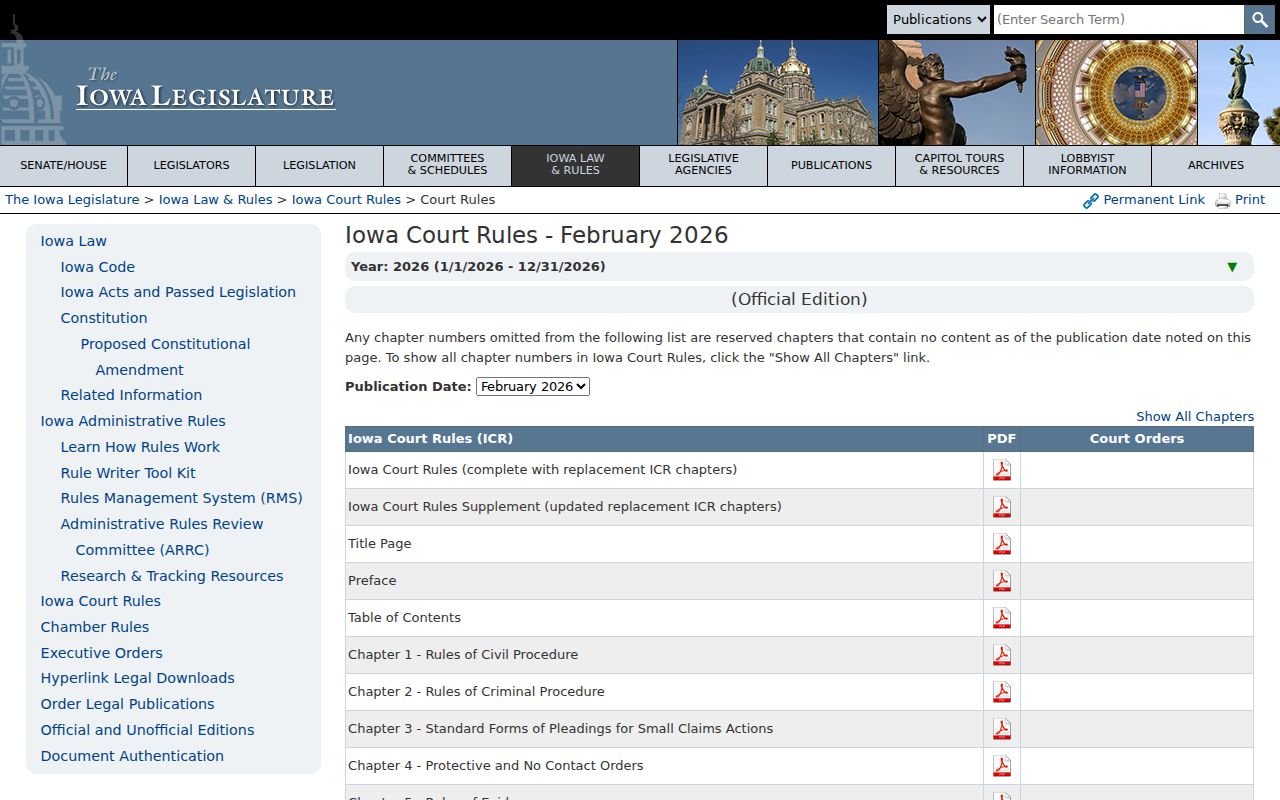
The rules help explain why an entry may be public while a protected filing or identifier remains unavailable.
Deferred Judgments in Page County Cases
A deferred judgment has its own record path. The court holds back judgment while the person completes stated conditions. A successful discharge is a nonconviction, and Iowa law can provide court-level expungement. Yet DCI explains that the entry can remain in its criminal-history record marked as discharged and may be released when the subject authorizes disclosure.
For that reason, do not read a Page County case caption alone. Check the event list for the order granting a deferred judgment, the discharge, and any later expungement order. Then compare the court result with a self-review from DCI if the state record is at issue. Iowa Code chapter 901C also provides narrower paths for qualifying dismissals, acquittals, and certain misdemeanors. It is not a rule that clears every case.
The current Iowa expungement chapter supplies the statutory limits that affect Page County case access.
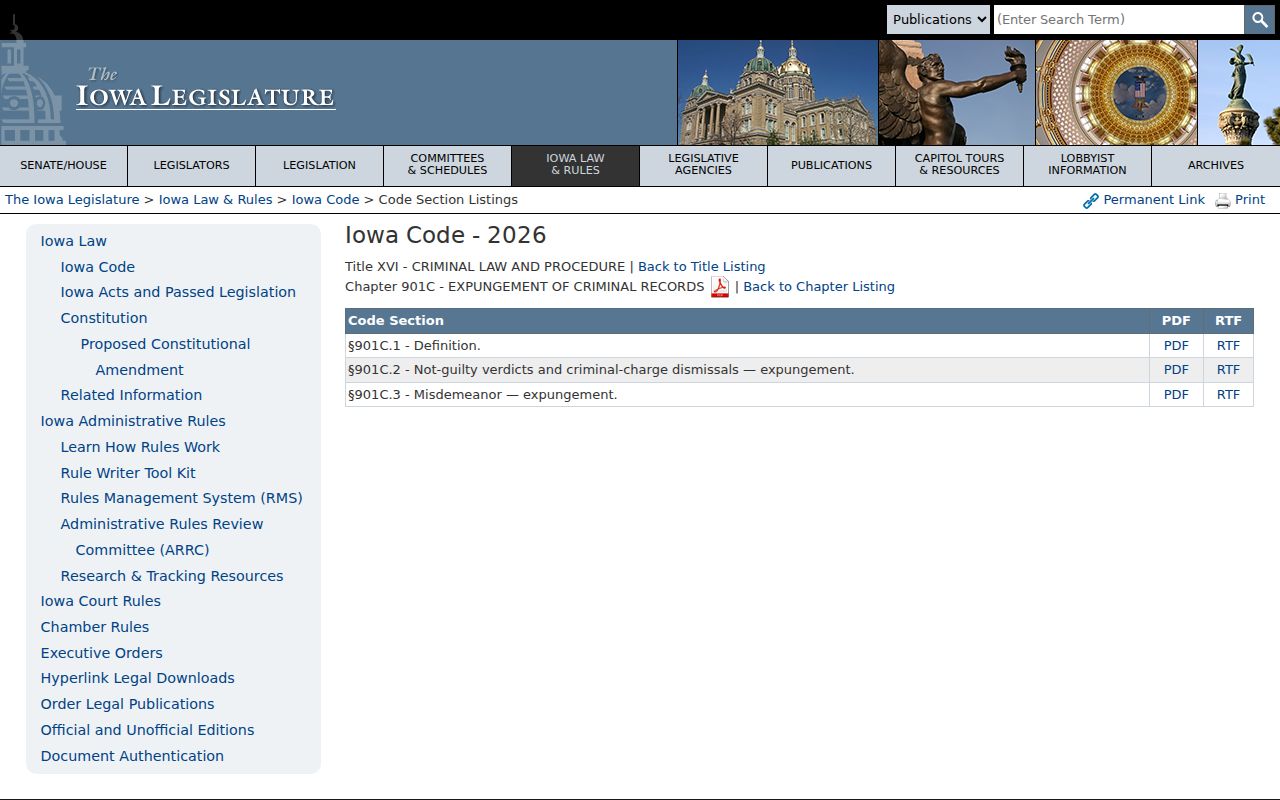
The statute should be matched to the exact disposition before someone asks the Page County clerk for the current form.
Page County Case Debt Fields
The financial part of a Page County court case can list a fine, surcharge, court costs, restitution or other debt, payments, and a balance. Those rows are part of the case docket, not proof by themselves that every charge ended in conviction. Match the money entry with the judgment and charge disposition.
Iowa's payment search does not require a subscription. It uses the county, case type, and case or citation number, or a name. The 10-to-14-day citation lag still matters. Before paying, confirm that Page County and the case ID match the intended record. Questions about how an amount was imposed belong with the clerk and the judgment, not with a guess drawn from the balance screen.
The Judicial Branch's official fine-payment instructions explain the approved payment route.

The payment page is useful after the right Page County case is identified, but it does not replace the judgment or sentence.
Page County Docket Index Limits
A docket index lists filings and orders. It does not promise that a guest can open every PDF. Some records may exist only through eFile access, at the courthouse terminal, or in the clerk's official file. Older material may also require staff retrieval. This distinction matters when the line title proves that an order exists but its terms are not visible online.
Use the index to name the precise document. A request for "everything" can be slower and may cost more than a request for one judgment, order, or charging paper. If the clerk cannot disclose an item, ask whether a public version or redacted copy exists. Iowa Court Rule 16.602 and Judicial Branch policies govern electronic access and confidentiality.
Note: The online docket is a finding tool; the Page County clerk's file is the record used for an official copy.
Case Record Access & Restrictions
Iowa Code chapter 22 generally supports examination and copying of nonconfidential public records, while court records also operate under Judicial Branch access rules. Page County court files can still contain protected material. Confidential juvenile matters, sealed or expunged records, protected victim or minor data, and personal identifiers may be absent, redacted, or unavailable to a guest.
When a Page County case does not appear, first check spelling, prior names, county, case type, and filing lag. Then contact the clerk. The clerk can confirm whether the issue is a search error, an old file, or a legal access limit, though staff cannot provide legal advice. Appeals from Page County District Court go to the Iowa appellate courts and can be searched through Iowa Courts Online when public.
Access point: A public docket can identify the case and outcome, but only the Page County clerk can provide an official certified court document.